
Quick answer: When you sell to a consumer in the EU, you answer for the parcel until it is handed over. You resend or refund, then claim from the carrier, within deadlines ranging from 3 days to 12 months. Compensation rarely covers the value of a light item.
Tracking hasn't moved for nine days, and your customer is writing for the third time. The carrier lost the parcel, but your customer is waiting for an answer from you. The law is on their side, and your claim against the carrier comes down to a few deadlines and a few documents.
Who pays: the seller first, the carrier next
Selling to a consumer in the EU? The risk of loss or damage stays with you until the customer, or a person they have named, takes physical possession of the parcel (Article 20 of Directive 2011/83/EU). The carrier doesn't count as that person. France sets this out in Article L216-2 of its Consumer Code, and Portugal in Article 11 of Decree-Law 84/2021.
So there's no point sending your customer to the carrier: the dispute over the parcel is between you and your carrier.
If the parcel never arrives, your customer can ask you to deliver within an additional period suited to the circumstances, then terminate the contract, and you reimburse all sums paid without undue delay (Article 18 of the Directive). National law can be stricter:
- France: refund within 14 days (Article L216-7).
- Portugal: refund within 14 days, doubled if you miss the deadline. The seller must also prove that the delivery obligations were met (Article 11 of Decree-Law 84/2021).
These rules have exceptions:
- The customer commissioned their own carrier, and you didn't offer that choice: the risk passes to them on handover to the carrier (Article 20).
- You sell to a business: these consumer rules don't apply, and your terms of sale or the Incoterm decide who bears the risk.
When does a parcel count as lost?
A parcel counts as lost when the carrier can no longer deliver or locate it, or when the period in its terms has run out. This period varies by carrier:
- DPD France: the parcel is deemed lost 30 days after the end of the delivery period, or 60 days for exports.
- CTT Expresso: for a total loss, the one-year limitation period starts on the 30th day after acceptance.
- La Poste: no fixed period in the Facilité contract. It decides on a body of evidence, and a missing scan alone doesn't establish a loss.
Don't wait for these periods to run out before acting. They fix when the loss is recorded, and nothing stops you opening an investigation as soon as tracking stops. ParcelRush flags late or blocked parcels, so you know which ones to deal with without watching every carrier's portal.
Lost parcel: the steps to follow
- Check the tracking. In ParcelRush, it opens in one click. Note the last scan, its date and its location. If the status says "delivered", go to the next section.
- Open an investigation with the carrier, using the tracking number. At La Poste, only the sender can claim, so your customer can't do it for you.
- Answer your customer with a date: resend or refund. Avoid making them wait for the end of the investigation: La Poste, for example, allows itself up to 2 months to reply.
- File the written claim within your carrier's deadline, with the file described below.
- Track your incidents by carrier. The ParcelRush dashboard groups them, so you can see where your losses are concentrated.
Tracking says "delivered", but the customer received nothing
The law looks at physical possession by the customer or by a person they have named. It doesn't go into detail about a letterbox or a neighbour. According to the EU's official information site, it's up to you to contact the carrier and prove delivery. Without proof, you send an identical item or refund.
Get the proof of delivery, in ParcelRush or from the carrier. Each carrier provides it in its own way: depending on the case, you'll find a signature, a drop-off location or the name of the person. Ask your customer to check with their neighbours and household too. UPS may leave a parcel in the letterbox or with a neighbour, and FedEx with a neighbour or in a safe place, unless you exclude these options. For valuable parcels, use delivery against signature to avoid this debate.
Damaged parcel: it all happens at delivery
Your customer has to act fast, and they don't know the rules. Tell them in your shipping email: check the parcel in front of the driver, note precise reservations if there's damage, take photos, keep the packaging and write to you the same day.
National rules vary. In France, receipt of the parcel ends any action against the carrier for damage or partial loss, unless a reasoned protest is sent within 3 days, public holidays excluded, by registered letter or bailiff's notice (Article L133-3 of the Commercial Code). This doesn't apply to international transport. The period rises to 10 days when the consumer takes delivery personally and the carrier can't prove it gave them the chance to check the parcel (Article L224-65 of the Consumer Code).
These deadlines concern the claim against the carrier. Your customer comes to you: the EU's official information site points out that the seller answers for damage during transport, and must repair, replace or refund.
Your packaging matters as much as your speed. The Colissimo Facilité contract rules out compensation for a badly packed parcel or packaging unsuited to its contents. CTT Expresso only examines a damage claim with the original packaging or photos of it. FedEx asks you to keep the contents, the original carton and the packaging available for inspection until the claim is settled.
Deadlines and limits by carrier
| Carrier | Loss: claim within | Damage: report within | Base limit |
|---|---|---|---|
| DHL Express | 30 days from acceptance | 30 days from acceptance | 8.33 SDR/kg by road, 26 SDR/kg by air |
| UPS (France, Portugal) | 60 days from handover to UPS | 14 days from receipt | €85 per shipment, or 8.33 SDR/kg if higher, unless international conventions apply |
| FedEx | 9 months from handover to FedEx | 21 days from delivery | €33/kg, €1,000 max, by road in mainland France (France addendum); elsewhere, the applicable convention |
| DPD France | Deemed lost after 30 days, 60 for exports; action within 1 year | Reservations at delivery; 3 working days in France, 7 international road, 14 air | €33/kg, €1,000 max; €660 max for pickup and returns |
| DPD Portugal | 30 days from effective or scheduled delivery | Reservations at delivery; 30 days in writing | National: €10/kg, €300 max per parcel. Road: 8.33 SDR/kg. Air: 16.58 SDR/kg |
| CTT Expresso | 30 days from the scheduled delivery date | 8 days from delivery | €10/kg nationally |
| Colissimo | 12 months in France, 6 months internationally, from acceptance | Same deadlines | €23/kg, €690 max; €33/kg, €990 max with signature |
These figures come from the public terms listed in the sources, in the version shown. Your contract may say otherwise, and it prevails: read its liability clause. For Colissimo, the table follows the 2020 Facilité contract; without a contract, La Poste's consumer page gives 30 days from sending for loss or damage. If in doubt, claim within those 30 days. The SDR (Special Drawing Right) is an international unit of account whose value changes daily; according to UPS's terms, 8.33 SDR is worth about €9.
The shortest deadline should shape how you work. With DHL Express, the 30 days run from acceptance of the parcel, so an investigation opened late can cost you your claim.
What compensation really covers
Take a 300 g bracelet sold for €150. It gets lost. You refund your customer €150 and receive €3 at most with CTT Expresso (0.3 kg × €10), or €6.90 with Colissimo to the door without signature (0.3 kg × €23), plus shipping costs if the parcel is lost entirely. Above 1 kg, Colissimo compensates the value of the contents, up to the per-kilo limit.
Even below the limit, your margin is gone. Colissimo looks first at the purchase value of the goods, and DPD France at the pre-tax amount of the original invoice for new goods. DPD France, DPD Portugal, UPS, FedEx and CTT Expresso also rule out loss of profit.
For a light and expensive item, extra cover is the answer:
- UPS, declared value: for a fee, up to the equivalent of USD 50,000 per parcel. Jewellery and watches, other than costume items, are limited to USD 500 per parcel.
- FedEx, declared value: for a fee, up to USD 50,000 per shipment in general. For jewellery, watches, smartphones and laptops, the limit falls to USD 1,000 per shipment, or the applicable convention limit if higher.
- DPD France, ad valorem insurance: up to €20,000 per parcel.
- CTT Expresso, Proteção Extra: an optional service with a maximum of €12,500, covering loss, misrouting and damage.
- Colissimo, Ad valorem option: in €100 steps, up to €1,000, to all destinations, with delivery in person against signature.
Our guide to choosing a carrier looks at the other criteria to compare.
The file to prepare
Put it together as soon as you open the investigation, because some documents are hard to find later:
- the parcel number and your customer number;
- the purchase invoice for the goods and the sales invoice to the customer;
- any reservations noted at delivery;
- photos of the packaging and contents, and the original packaging if possible.
Some carriers ask for more. DPD France also wants a statement saying whether the goods were insured and, if the customer disputes the signature, a certificate of non-receipt. The purchase invoice carries weight at Colissimo: without it, compensation falls to 70% of the selling value shown on the sales invoice, and with neither document, nothing is paid.
Reducing incidents
- Protect the contents: wedge them and match the carton to their weight. Our article on empty space and the PPWR helps you size your cartons.
- Get valuable parcels signed for: a signature settles the "delivered but not received" debate, and it raises the limit at Colissimo.
- Take care of addresses: a visible second address line and a phone number requested at checkout help the driver. With ParcelRush, the order arrives from your store with its address, without retyping, and the label won't generate if the phone number is missing or the postcode is wrong, so you correct it before shipping. A wrong street number can't be detected, and only your customer can spot it: we're not psychic yet ;)
- Compare your carriers on your own figures: your loss and damage rate per carrier gives you a solid argument to negotiate your rates. The ParcelRush dashboard gives you these figures over 7 days, 6 months or a year.
Spotting problems before your customer does
A loss is easier to handle when you find out before your customer. ParcelRush brings the tracking of all your parcels into one place, whichever the carrier: DHL, UPS, FedEx, DPD, CTT or Colissimo. You can write to your customer or chase the carrier before the situation gets worse, while the claim deadline is still running.
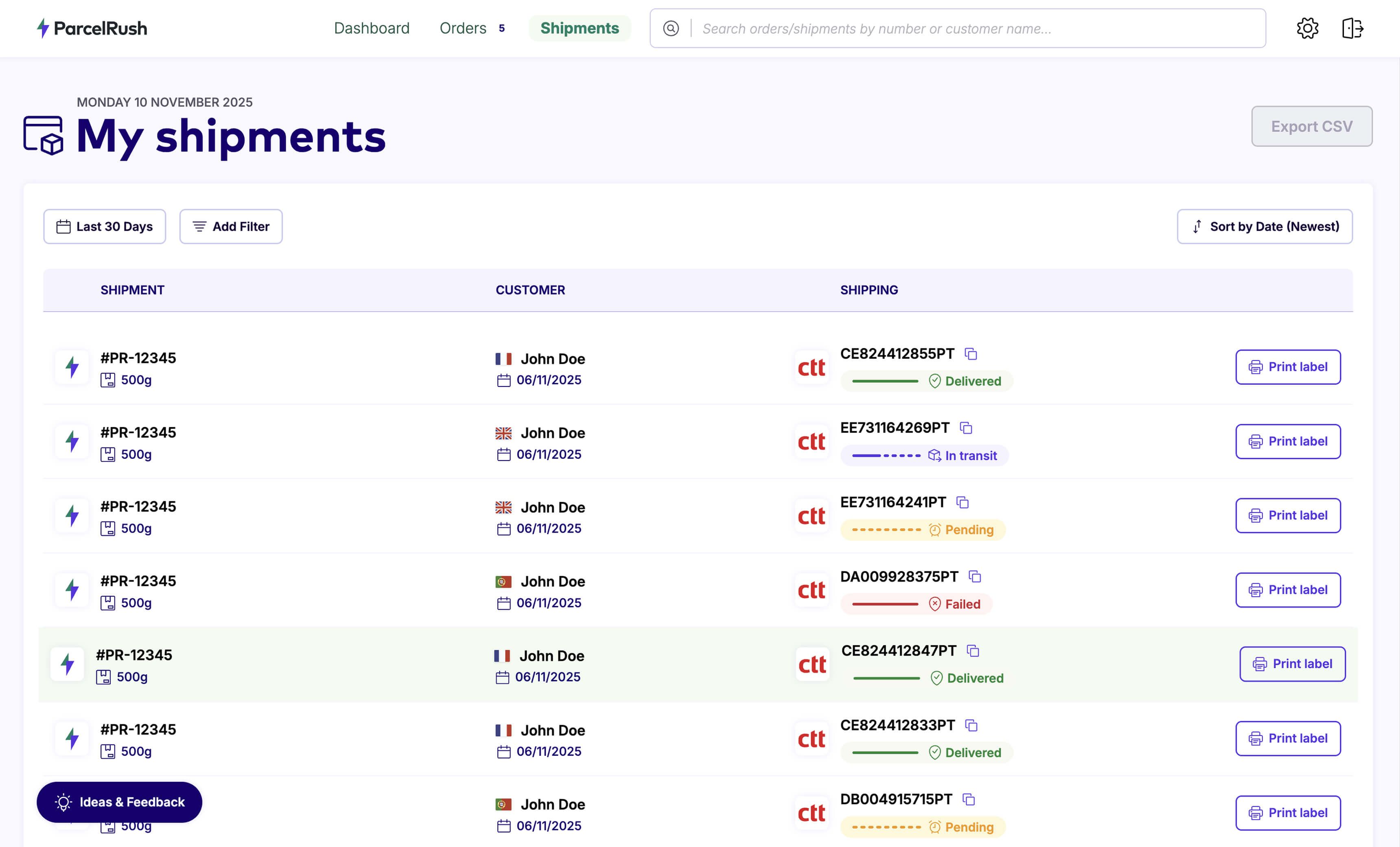
You ship with your own contracts, so the claim goes directly to your carrier, with no intermediary between you.
To try it on your own orders, your first 10 labels are free, with no credit card or subscription.
Laws and terms consulted on 4 and 5 November 2026, unless a version is given in the sources. This article gives general guidance: for a significant dispute, have your situation checked by a legal professional.
Frequently asked questions
Who refunds a lost parcel: the seller or the carrier?
When you sell to a consumer in the EU, the seller. Under Article 20 of Directive 2011/83/EU, the risk stays with you until the customer, or a person they have named, takes physical possession of the parcel. You resend or refund, then claim compensation from the carrier.
How long before a parcel counts as lost?
It depends on the carrier. At DPD France, a parcel is deemed lost 30 days after the end of the delivery period, or 60 days for exports. La Poste sets no fixed period: it relies on a body of evidence, and a missing scan is not enough. Open an investigation as soon as tracking stops moving.
How long do you have to claim for a lost parcel?
Under public terms: 30 days from acceptance at DHL Express, 60 days from handover at UPS, 9 months at FedEx, 30 days from the scheduled delivery date at CTT Expresso and DPD Portugal. At Colissimo, the Facilité contract allows 12 months in France and 6 months internationally. Your contract may say otherwise, and it prevails.
How much compensation does a lost parcel bring?
Base compensation is usually calculated by weight. For a 300 g item, the limit is 3 euros at CTT Expresso (10 euros per kg) and 6.90 euros with Colissimo without signature (23 euros per kg), whatever its selling price. For a light and expensive item, take the cover your carrier offers.
Should the customer report a damaged parcel on delivery?
Yes, with precise reservations and photos. At DPD Portugal, goods accepted without a noted objection are presumed to be in good condition. In France, the claim against the carrier closes 3 days after receipt, public holidays excluded, without a reasoned protest.
Does a "delivered" status prove the customer received the parcel?
Not always. EU law looks at physical possession by the customer or by a person they have named, and the seller must be able to prove delivery. Get the proof of delivery, and use delivery against signature for valuable parcels.
Sources
- Directive 2011/83/EU on consumer rights, Articles 18 and 20, EUR-Lex
- Directive 2011/83/EU on consumer rights, Articles 18 and 20, legislation.gov.uk
- Your Europe, Shipping and delivery FAQ (last checked 17 August 2026)
- France, Consumer Code, Articles L216-2, L216-3, L216-6 and L216-7, Légifrance
- France, Consumer Code, Article L224-65, Légifrance
- France, Commercial Code, Articles L133-1, L133-3 and L133-6, Légifrance
- Portugal, Decree-Law 84/2021, Article 11
- DHL Express, Terms and Conditions of Carriage
- UPS, Terms and Conditions of Carriage (France)
- UPS, Terms and Conditions of Carriage (Portugal, 2024 guide)
- FedEx, Conditions of Carriage for Europe (15 January 2026)
- DPD France, General Terms and Conditions (1 November 2026)
- DPD Portugal, Terms of transport
- CTT Expresso, General conditions of carriage
- CTT, Expresso Entre Cidades and Proteção Extra
- Colissimo, Facilité contract terms (edition of 8 December 2020)
- La Poste, Colissimo guarantees and compensation for businesses (September 2026)
- La Poste, lost Colissimo parcel

Maëlle Lemarchand CEO of ParcelRush. 15 years in web, UI/UX and e-commerce. Writes about shipping, logistics, e-commerce and marketing. LinkedIn