A customer orders £70 from your store. The parcel arrives, the carrier asks for £29 before handing it over. They refuse. The parcel goes back, and you have paid for shipping twice without selling anything.
This has a name: you shipped DAP without telling your customer. This guide covers the difference between DDP and DAP, the confusion that costs more than the choice itself, and how to decide now that the EU charges duty on every parcel.
This guide is for stores shipping from outside the EU (UK, Switzerland, US, Asia…) to European buyers. If you ship from within the EU to EU customers, there are no import duties and the question does not arise.
Quick answer: DDP means the store pays import duties and import VAT; DAP means the customer pays them on arrival, plus a carrier clearance fee. DDP protects the buying experience and cuts refused deliveries, but exposes you to import VAT that is not always recoverable. The most expensive mistake is not picking the wrong one: it is confusing the Incoterm, a clause in your sales contract, with your carrier's billing option, which is only an instruction about who receives the invoice. Get them out of sync and you pay for a promise you did not keep.
DDP and DAP: the real difference
Both are Incoterms, the rules published by the International Chamber of Commerce that split costs and responsibilities between seller and buyer. The version in force is Incoterms 2020. Both require the seller to deliver the goods to the destination. They part company on the last metre only: import clearance.
| DAP | DDP | |
|---|---|---|
| Carriage to destination | Store | Store |
| Export formalities | Store | Store |
| Import duties | Customer | Store |
| Import VAT | Customer | Store |
| Carrier clearance fee | Customer | Store |
| Does the customer pay anything on arrival? | Yes | No |
Under DAP, the price your customer sees at checkout is not the price they will pay. Under DDP, it is.
What about DDU?
You will often see "DDU", for Delivered Duty Unpaid, in carrier portals and shipping software. That is the old name. The International Chamber of Commerce removed it from the Incoterms in 2010, merging it with three other D terms into the new DAP. DDU has not been an official Incoterm for fifteen years, even though the habit outlived it.
The obligations are the same: the seller delivers to the destination, the buyer clears customs and pays the duties. If your interface offers DDU, read DAP. But in your terms of sale and your contracts, write DAP: that is the term with an enforceable definition today.
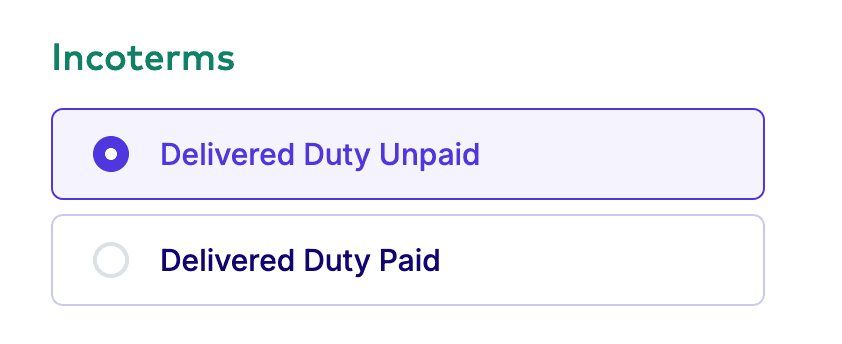
What this means in practice: the choice is made shipment by shipment, when you create the label. In ParcelRush it is a single option to tick before buying the label, and it carries through to the customs documents produced with it.
The confusion that costs more than the choice
Here is the point almost no guide covers, and the one that causes most of the damage in practice.
The Incoterm and your carrier's billing option are two different things.
The Incoterm is a clause in the contract between you and your customer. It lives in your terms of sale and decides who legally bears what.
The billing option is an instruction you give the carrier when you create the shipment, telling it who to invoice for duties. At DHL Express it is called Duty Taxes Paid: the carrier advances the duties and import VAT, then bills them back to you with a service charge on top. UPS lets you nominate shipper, receiver or a third party. At FedEx the choice is made on the air waybill, and if you select nobody, the receiver pays by default.
DHL states explicitly that its duty billing services should not be confused with Incoterms: the first is an instruction to the carrier, the second is part of the contract between sender and recipient.
The consequences are very concrete:
- You can switch the billing option on while your terms of sale say nothing about DDP. You pay the duties, nothing obliges you to, and you have no basis to pass them on.
- You can advertise DDP to your customer and forget to set the option on the shipment. They get a payment request at the door, the exact thing you promised to spare them.
- In a dispute, the contract decides, not the shipping label.
If you advertise "duties included", write it into your terms of sale and set the option on every shipment. Both, every time.
What each option actually costs
Under DAP your customer pays three things on delivery: import duties, destination import VAT, and a carrier clearance fee. That last one is what hurts. It is a flat amount per shipment, unrelated to the value of the goods. On a €30 order it can exceed the duty itself.
Under DDP you pay the same amounts, plus a carrier charge for advancing them. The figure is in your contract rate card: check it, because it varies a lot by destination and by negotiated terms.
The calculation that matters is not which one is cheaper per parcel. It is this one: what does a refused delivery cost you? Outbound carriage, return carriage, stock tied up for weeks, a refund, and a customer who will not come back. Against that, the DDP charge is usually cheap.
What changed with the €3 EU duty
Since 1 July 2026, the duty exemption on parcels under €150 is gone and a flat duty applies per tariff subheading on e-commerce imports into the EU. We covered the measure in detail in The EU's €3 customs duty: the anti-Shein measure that also hits small sellers.
For the subject of this article, the consequence is blunt: parcels that used to clear with no charge at all now generate one. Low-value orders, precisely the ones where DAP bothered nobody, have become the most exposed to a refused delivery. If you have not revisited your default Incoterm since July, now is the time.
How to decide
There is no single answer, there is a rule per flow.
Choose DDP when you sell to consumers, when your positioning rests on the buying experience, or when you ship to destinations where the clearance fee is large relative to your average order value. It is also the right call if you sell on marketplaces that require a final price with no surprises.
Choose DAP when you sell to businesses that have their own customs broker and prefer to handle clearance, when order values are high enough for the flat fee to disappear into the total, or when the destination country makes DDP impractical for a non-established seller.
Check before making DDP your default: under DDP your store bears import VAT in a country where it is most likely not VAT registered. If that tax is not recoverable, it stops being an advance and becomes a permanent cost, shipment after shipment. The rule depends on the destination country and on your tax position: take it to your accountant, not to your shipping software.
To find out what is actually charged at a given destination, the European Commission runs Access2Markets, where you can look up duties and formalities by product and country from an HS code.
Before you ship, check
- Your terms of sale say explicitly who pays import duties.
- The billing option is set on the carrier side, and matches what you advertised.
- Your product page and your checkout say the same thing, with no ambiguity.
- Your HS codes are correct: they determine the amount due, and therefore what your customer pays under DAP. See our guide to HS and HTS codes.
- Your commercial invoice travels with the parcel, carrying the real description, value and origin of every item. See customs compliance in 9 steps.
With ParcelRush, customs documents, CN22, CN23 and the commercial invoice, are produced at the same time as the label, and an HS code is suggested for every item. That saves you the manual data gathering and cuts keying errors. It does not remove your obligations: you remain the declarant and you are responsible for the accuracy of what you declare.
That leaves the question of the form itself. It turns on the shipping channel, postal or courier, before it turns on the amount: see the form that applies to your shipment.
Sources
- Incoterms 2020, International Chamber of Commerce (ICC), the body that publishes and revises the rules.
- Duty Billing Services, DHL Express, on the Duty Taxes Paid service and the distinction from Incoterms.
- Incoterms and payment options (PDF), UPS, on nominating who pays duties and taxes.
- Who pays duties and taxes? and the duty and tax billing guide, FedEx.
- Customs procedures for import and export, European Commission, Taxation and Customs Union.
- Access2Markets, European Commission, to look up duties and formalities by product and destination.
Frequently asked questions
What is the difference between DDP and DAP in one sentence?
Under DDP the store pays the import duties and import VAT; under DAP the customer pays them on arrival, usually to the carrier, before the parcel is released.
Is DDP the same as my carrier's «bill duties to shipper» option?
No, and the confusion is common. DDP is an Incoterm, a clause in the contract between you and your customer. The carrier billing option is an instruction telling the carrier who receives the duty invoice. You can switch one on without having agreed the other. DHL states explicitly that the two must not be confused.
What happens if I do not specify who pays?
The recipient pays. FedEx states that if you do not select a party on the air waybill, duties and taxes default to the receiver. That is exactly how a customer ends up with an unexpected bill at the door.
Can I reclaim the import VAT I pay under DDP?
It depends on the destination country and on your tax position. Under DDP you bear import VAT in a country where you are most likely not VAT registered, and if it is not recoverable it stops being an advance and becomes a permanent cost. Check with your accountant before making DDP your default.
Does DDP remove my customs declaration obligations?
No. DDP determines who pays, not who declares. Declaration obligations remain, and the declarant is still responsible for the accuracy of HS codes, descriptions, origin and value.
My software offers DDU, not DAP. Are they the same?
In practice yes, the obligations are identical. But DDU is the old name: the International Chamber of Commerce removed it from the Incoterms in 2010 and replaced it with DAP. Read DAP when you see DDU, and write DAP in your terms of sale.
Does the €3 EU duty change the calculation?
Yes. Low-value parcels used to clear with no charge at all, so DAP went unnoticed. Since 1 July 2026 a flat duty applies per tariff subheading, so those same parcels now generate a charge on arrival. They are the ones most exposed to refused deliveries.

Maëlle Lemarchand CEO of ParcelRush. 15 years in web, UI/UX and e-commerce. Writes about shipping, logistics, e-commerce and marketing. LinkedIn