Quick answer: the HS code is a 6-digit code, the same in more than 200 countries and economies. For a store shipping from the EU, the rule fits on one line: 8 digits in Europe (the Combined Nomenclature, which an export declaration requires), 10 digits for the United States (their own code). The EU's 10-digit TARIC code is only required for imports into the EU. On postal forms, the shared 6 digits are what is asked for. To find your code, describe the product the way customs sees it (material, how it is made, what it is for), look it up in the Commission's TARIC database or the destination country's tariff, and check existing rulings. If in doubt, customs can issue a Binding Tariff Information decision, free of charge and valid for three years.
A wrong customs code does not show straight away. The parcel leaves, the label prints, and it is on arrival that customs asks for details, applies a different rate or holds the shipment.
What an HS code is
The Harmonized System is the nomenclature that classifies every product traded internationally. It is maintained by the World Customs Organization and used by more than 200 countries and economies.
The code reads from left to right, from the broadest to the most precise:
- the first 2 digits give the chapter (61: knitted clothing, 62: clothing that is not knitted),
- the first 4 give the heading (6203: men's suits, jackets, trousers),
- the 6 digits give the subheading (6203 32: jackets of cotton).
This code decides what customs does with your parcel: the duty rate applied, any restrictions or licences, and foreign trade statistics. Since 1 July 2026, it also sets how many €3 flat-rate duties are due on low-value parcels entering the EU from a non-EU country, since that duty is counted per tariff category (see EU customs compliance for e-commerce shipments).
The system is revised about every five years. The current edition dates from 2022. The next one, HS 2028, was adopted at the end of 2025 and will apply from 1 January 2028: some codes in your catalogue will change on that date.
6, 8 or 10 digits: which one to use
The first 6 digits are shared by every country that applies the Harmonized System. Beyond that, each country or customs union adds its own subdivisions.
| Level | Digits | Defined by | What it is used for |
|---|---|---|---|
| HS code | 6 | World Customs Organization | Shared base, postal forms, invoices |
| Combined Nomenclature (CN) | 8 | European Union, republished every year | Customs duties and statistics in the EU |
| TARIC | 10 | European Union | Import declarations into the EU: the last 2 digits carry trade measures (suspensions, quotas, anti-dumping) |
| HTSUS | 10 | United States (8 tariff digits and 2 statistical) | US import entries |
In practice, for a store shipping from the EU:
- on CN22 and CN23 forms, 6 digits, the field the postal form provides,
- to the United States, 10 digits, those of the US code,
- in Europe, 8 digits, the Combined Nomenclature: this is the nomenclature you classify your catalogue in, and the code an export declaration asks for. The EU regulation that sets out what customs declarations must contain requires the 8 digits for exports, and the 10-digit TARIC code for imports only.
TARIC only concerns you if you bring goods into the EU, for example stock bought outside the EU.
And a 10-digit EU code and a 10-digit US code are not interchangeable: they share the first 6 digits, nothing more. The 2026 Combined Nomenclature is set by Commission Implementing Regulation (EU) 2025/1926, published in the Official Journal on 31 October 2025.
Worked example: the EU code for a men's jacket
"Men's jacket" is not enough to find a code. Three questions change the classification, in this order.
1. Knitted or woven? That is the chapter. A knitted jacket falls under chapter 61, a woven one under chapter 62.
2. What type of jacket? That is the heading. For a woven garment:
- a blazer or suit-type jacket falls under heading 6203 (jackets and blazers),
- an anorak, windcheater or wind-jacket falls under heading 6201.
3. What material? That is the subheading, and the Combined Nomenclature sometimes adds one more criterion.
| Product | HS code (6) | CN 2026 (8) | What decides the last digits |
|---|---|---|---|
| Men's cotton blazer | 6203 32 | 6203 32 90 | Not industrial or occupational clothing |
| Men's synthetic-fibre blazer | 6203 33 | 6203 33 90 | Not industrial or occupational clothing |
| Men's synthetic-fibre wind-jacket, 1 kg or less | 6201 40 | 6201 40 10 | The weight of the garment |
| Men's synthetic-fibre wind-jacket, over 1 kg | 6201 40 | 6201 40 90 | The weight of the garment |
For shipments leaving the EU, these 8 digits are all you need on the European side. If you were importing these jackets into the EU, the import declaration would ask for the TARIC code: 6203 32 90 00 for the cotton blazer, and one of three possible codes for the wind-jacket of 1 kg or less.
On the US side, the same logic leads to different codes, and to very different rates (general rates from the 2026 edition, excluding additional duties):
- men's cotton blazer: 6203.32.20.40, 9.4%,
- men's synthetic-fibre blazer: 6203.33.20.10, 27.3%,
- men's synthetic-fibre wind-jacket: 6201.40.75.11, 27.7%, or 6201.40.70.00 if it meets the US definition of a water-resistant garment, 7.1%.
Two jackets that nothing distinguishes on a product page can therefore pay anywhere from 7.1% to 27.7% on entry into the United States. That is why the description matters as much as the code.
More examples, and what changes the code
Codes from the 2026 Combined Nomenclature.
| Product | CN 2026 (8) | The criterion that matters |
|---|---|---|
| Cotton T-shirt (knitted) | 6109 10 00 | Knitted, cotton |
| Leather jacket | 4203 10 00 | Leather or composition leather |
| Green tea in packs of 3 kg or less | 0902 10 00 | The packaging |
| Green tea in bulk, over 3 kg | 0902 20 00 | The packaging |
| Green coffee, not roasted, not decaffeinated | 0901 11 00 | Roasting, decaffeination |
| Red Bordeaux PDO wine, 15% vol or less, bottle of 2 l or less | 2204 21 42 | Designation, colour, strength, container |
| Smartphone | 8517 13 00 | Subheading created in 2022 |
| Bluetooth headphones or earphones | 8518 30 00 | Same code with or without a microphone |
| Non-motorised bicycle, with ball bearings | 8712 00 30 | The type of bearing |
Tea shows the trap clearly: the same green tea changes code depending on whether it is sold in 100 g packs or a 5 kg sack. And smartphones, classified under 8517 12 until 2021, have had their own subheading since HS 2022. A catalogue coded before then may still carry codes that no longer exist.
Finding your product's code in 5 steps
1. Describe the product the way customs sees it
The trade name means nothing at customs. Note the material (and its share if the product mixes several), how it is made (knitted, woven, moulded), what it is for, who it is for (men, women, children) and how it is packed. "Aurora sweatshirt" tells a customs officer nothing. "Men's knitted hooded sweatshirt, 80% cotton 20% polyester" lets them classify it.
2. Find the chapter and the heading
The titles of sections and chapters are for reference only. What is legally binding is the wording of the headings and the section and chapter notes. That is the first of the six General Interpretative Rules that govern every classification. So read the chapter notes before you choose: they often exclude products you would instinctively place there.
3. Go down to the right level in the official database
| Database | What it gives you | When to use it |
|---|---|---|
| TARIC | CN and TARIC codes, measures applicable in the EU | Your reference for classifying your products |
| Access2Markets | Duties and formalities in the destination country, by code or keyword | Before selling in a new non-EU country |
| US HTS | The 10-digit US code and its rate | Any shipment to the United States |
| UK Trade Tariff | The UK tariff | Any shipment to the United Kingdom |
Your national customs administration also publishes its tariff, with explanations in your language: RITA in France, the Pauta Aduaneira of the AT in Portugal.
4. Check rulings already issued
Someone has very probably already had a product close to yours classified. The EU's EBTI database publishes the Binding Tariff Information decisions issued in the EU, valid or expired. For the United States, the CROSS database publishes US customs rulings. Search by keyword and read the description of the classified product: if it matches yours, you have your code.
Your supplier's code is a good starting point, not an answer. Only its first 6 digits are valid everywhere. If it was set in China or the United States, the rest does not match the EU nomenclature.
5. If in doubt, apply for Binding Tariff Information
A BTI is a written decision by customs on the classification of a specific product. It is free of charge, valid for three years, and binding on every customs authority in the EU for that product. Applications are made electronically, and customs has 120 days from accepting the application to decide. The European Commission explains the procedure on its BTI page. For a best-selling product, or one whose classification hesitates between two rates, it is the strongest guarantee.
The mistakes that hold parcels or cost money
- A vague description. "Clothing", "gift", "accessories" or "toys" make it impossible to check the code. Customs then asks for details, and the parcel waits.
- A code from another nomenclature copied as is. A 10-digit US code on a document meant for the EU, or the other way round.
- An outdated code. Codes change with every edition of the Harmonized System, and the Combined Nomenclature is republished every year. Plan a review of your catalogue before 1 January 2028.
- One code for the whole catalogue. Your products do not all share the same material or use. One code per product, not per store.
- A code that contradicts the description or the value. The code says "cotton", the description says "polyester": that is the kind of mismatch that triggers a check.
Where the code must appear
On CN22 and CN23 postal forms. They include a field for the 6-digit HS code. Since 1 June 2026, Universal Postal Union rules require the sender of a commercial item to fill it in when the destination country asks for it.
On the commercial invoice. Give the code for each line and the country of origin of each item. DHL Express recommends giving the full code of the importing country where possible, not just the 6 digits.
To the United States. Since the end of the $800 de minimis exemption, every parcel goes through an import entry. In the simplified postal process, that entry must carry every applicable 10-digit US code. The details are in our article on shipping to the US by post.
Which form to attach depends first on the shipping channel, postal or express. Our customs documents checker tells you which one applies to your parcel.
What ParcelRush does, and what it doesn't
In ParcelRush, the HS code is suggested from each product's title and description, with a confidence score. You check it, correct it if needed, and it is then carried over to the customs documents of every international shipment, along with the country of origin.
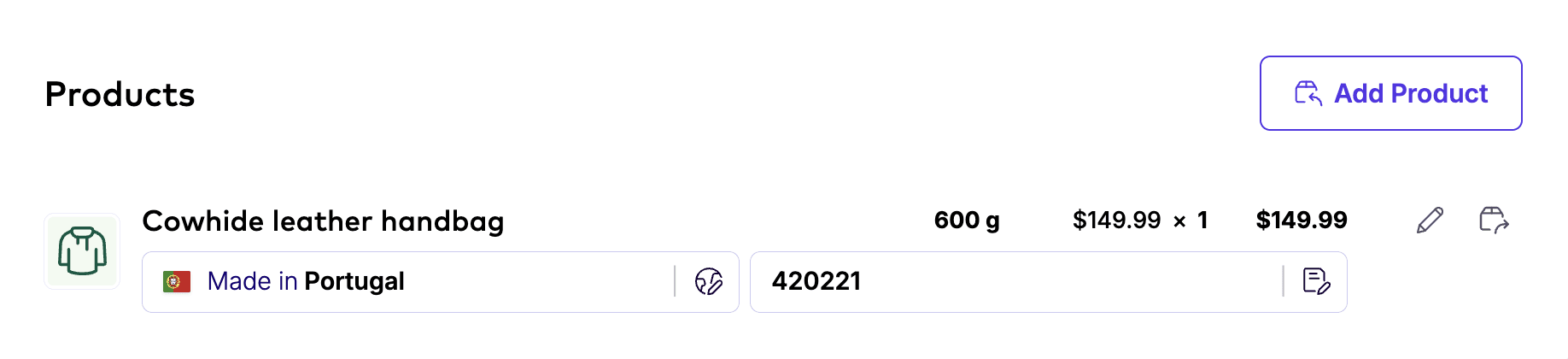
A suggestion is not a classification. The more precise your description (material, how it is made, what it is for), the more accurate it is. And you are always the one declaring: customs deals with the sender, not with the sender's software.
FAQ
Is an HS code the same as a tariff code or a commodity code?
The HS code is the 6-digit base defined by the World Customs Organization. Tariff code and commodity code are the names used for the longer national versions built on it: 8 digits in the EU Combined Nomenclature, 10 digits in TARIC, in the US schedule and in the UK tariff.
How many digits go on a CN23 or a commercial invoice?
At least the 6 digits of the HS code, which are shared by every country. The postal form has a 6-digit field. On the commercial invoice, DHL Express recommends giving the full code of the importing country where possible. For the United States, the entry must carry the 10-digit US code.
Is the code my supplier gave me valid?
Only its first 6 digits are shared by every country. Beyond that, the code depends on the nomenclature of the country that issued it. A 10-digit Chinese or US code is not valid in the European Union, and the reverse is also true. Check it in the official database of the country concerned.
Can an HS code change?
Yes. The Harmonized System is revised about every five years. The 2022 edition, for example, created a dedicated subheading for smartphones. The next one, HS 2028, comes into force on 1 January 2028. The EU Combined Nomenclature is republished every year.
Who is responsible for the code declared?
The sender, or the declarant acting on their behalf. Software can suggest a code, but you are the one who confirms it and answers for it to customs.
Further reading
- Shipping to the US by post, what still goes through, and what the entry requires
- DDP or DAP: who pays the import duties, the choice that decides the bill on arrival
- EU customs compliance for e-commerce shipments, the €3 duty and the data to send
- Customs documents checker, CN22, CN23 or commercial invoice depending on destination and carrier
Sources
- What is the Harmonized System, World Customs Organization, for the 6-digit structure and the number of countries using it.
- HS 2028 amendments, World Customs Organization, 21 January 2026, for HS 2028 coming into force on 1 January 2028.
- Commission Delegated Regulation (EU) 2021/234, Official Journal L 63 of 23 February 2021, data requirements tables: Combined Nomenclature code mandatory in the export declaration (column B1), TARIC code mandatory in the declaration for release for free circulation (column H1). Tables unchanged on this point in the consolidated version of 1 July 2026 of Delegated Regulation (EU) 2015/2446.
- Commission Implementing Regulation (EU) 2025/1926, Official Journal of 31 October 2025: 2026 Combined Nomenclature, 8-digit codes and General Interpretative Rules.
- TARIC consultation and EBTI database, European Commission, consulted on 9 October 2026.
- EU Binding Tariff Information (BTI), European Commission, and the Union Customs Code, Article 22 for the 120-day time limit, Article 33 for the three-year validity and Article 52 for the absence of charges.
- Harmonized Tariff Schedule of the United States, U.S. International Trade Commission, 2026 edition, for US codes and rates.
- Indefinite Suspension of the De Minimis Exemption for Mail Shipments, U.S. Customs and Border Protection, 24 June 2026, for 10-digit US codes in the postal process.
- Circular 86 of 31 May 2024, Universal Postal Union, for the requirement of a 6-digit HS code on commercial items from 1 June 2026.
- Global Customs Customer Guidelines, DHL Express, January 2026, for the recommendation on the commercial invoice.

Maëlle Lemarchand CEO of ParcelRush. 15 years in web, UI/UX and e-commerce. Writes about shipping, logistics, e-commerce and marketing. LinkedIn