Free shipping is never free. It is paid for, just not by the customer. It comes out of your gross margin, order after order, and it is the only line in your accounts that you deliberately choose to grow.
What makes the decision hard is not whether to do it. It is knowing from what order value you can do it without it costing more than it brings in.
Quick answer: the free shipping threshold is calculated from three numbers that are yours alone, your average order value, your gross margin rate and what a shipment really costs you, packaging and volumetric weight included. The floor is the shipping cost divided by the margin rate: with €6 of shipping and 60% margin, you lose money below a €10 order. The amount to display in your store is the higher of that floor and your average order plus 20 to 30%, so €50 for a €40 average order. Show it on the product page and not at checkout: according to the Baymard Institute, 40% of shoppers who abandon their cart cite extra costs as too high.
What free shipping actually costs you
Take a €40 order at 60% gross margin. Your margin on that order is €24. If the shipment costs you €6 all in, packaging included, you keep €18.
On a €15 order at the same margin, you collect €9 of margin and still spend €6 on shipping. You keep €3. The same free delivery has taken two thirds of your margin.
That is where the real question sits. The shipping cost is roughly fixed, the margin is proportional to the order. The smaller the order, the heavier free shipping weighs, until it eats everything.
Break-even, the one number that is not negotiable
That tipping point takes one operation:
Break-even = cost of one shipment ÷ gross margin rate
With €6 of shipping and 60% margin: 6 ÷ 0.60 = €10. On a €10 order, your gross margin is €6, exactly what delivery costs. You are at zero. Below that, you are paying to sell.
Two details matter, because they change the result.
The margin rate is the gross margin rate, what is left after the cost of the goods, before rent, salaries and platform fees. The calculation does not claim to cover your fixed costs, only shipping. Your real profitability floor is therefore higher than this number.
The shipping cost is the real cost, not the headline rate. It includes packaging, and it accounts for volumetric weight: carriers bill the higher of the actual weight and the weight calculated from the dimensions. A light parcel in a big box is billed by volume. Ignore that mechanism and your threshold is wrong from the start. How to calculate volumetric weight covers how to find it carrier by carrier.
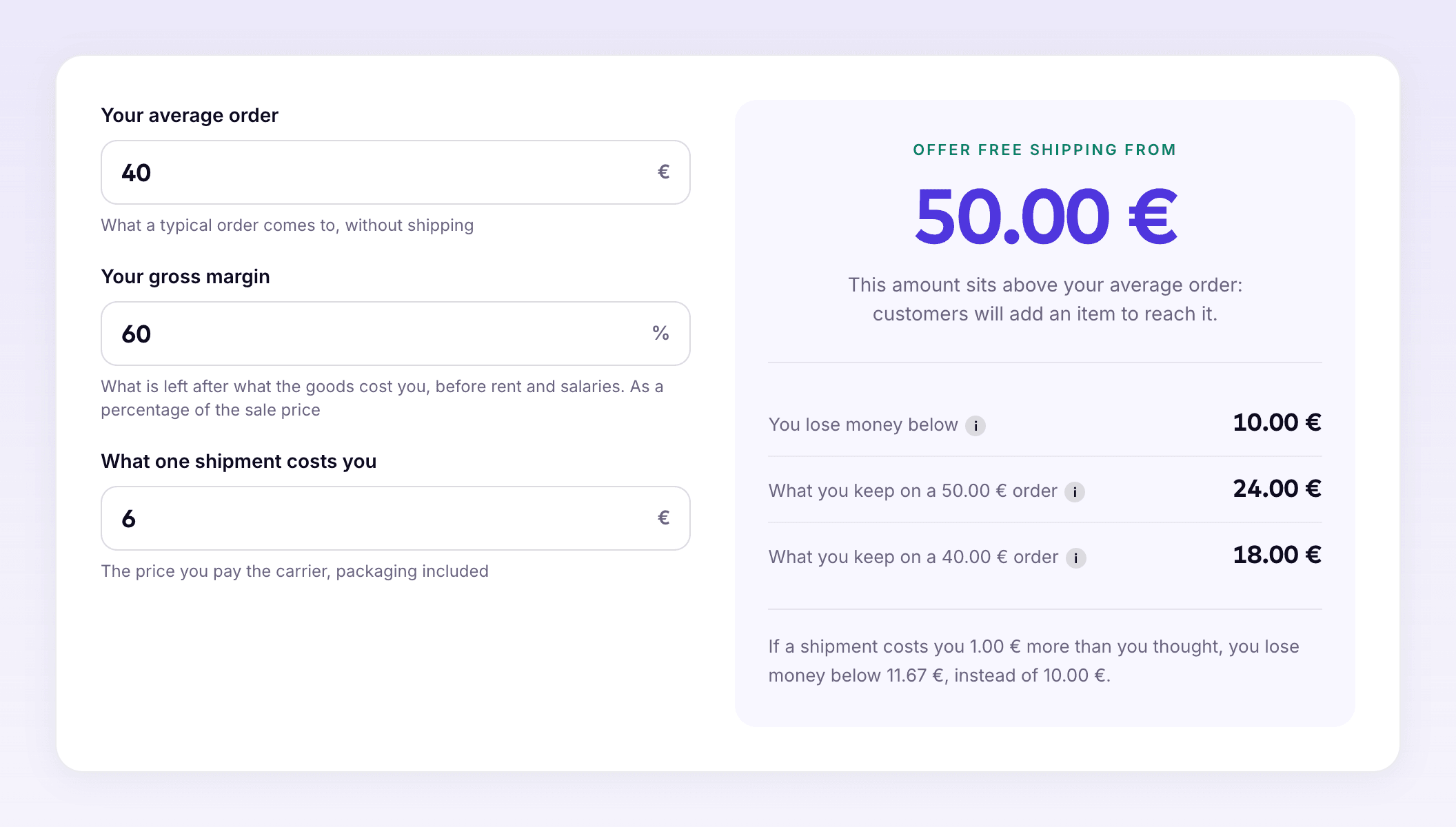
To put your own numbers in without doing the arithmetic, our free shipping threshold calculator asks for three fields. With the example above, a €40 average order, 60% margin and €6 of shipping, it shows the threshold to announce in your store, the floor below which you lose money, and what you keep on an ordinary order.
The amount you display is not the break-even
Break-even tells you where you stop losing money. It is not the amount to display.
If you announce "free shipping from €10" when your average order is €40, you are giving away delivery on nearly every order. The threshold no longer does anything: it makes no one work, it just costs you €6 an order.
A useful threshold is one the customer has to reach. The industry convention puts it 20 to 30% above the average order value. With a €40 average order, that means displaying somewhere between €48 and €52. Close enough that adding an item feels reasonable, high enough that it changes the order value.
That range is professional practice, not a published study result. Treat it as a starting point to observe, not a truth. If your range has few low-priced products, a customer cannot fine-tune their basket, and the threshold should sit closer to the average order.
Keep the rule: you display the higher of the two, break-even or the marked-up average order. If your margins are tight enough that break-even exceeds what you would have displayed, break-even wins, and the message is clear: your cost structure does not let you offer free shipping yet.
Three mistakes that turn the threshold into a loss
Not showing the amount on the product page
This is the most expensive mistake, and the best documented. The Baymard Institute measures an average cart abandonment rate of 70.22%, calculated from 50 studies. Among shoppers who abandon for a reason other than browsing, 40% cite extra costs as too high, shipping first among them.
The important word is "extra". What drives the buyer away is not the price of delivery, it is discovering it when they thought they were done. The same institute finds that 64% of shoppers look for the shipping cost on the product page before adding to cart, and that 43% of sites show nothing there. One in five US shoppers abandoned an order in the past quarter because they could not see the total before entering checkout.
Your threshold only works if it is visible while the customer is building their basket. Shown at checkout, it no longer prompts anyone to add anything: it announces bad news at the most fragile step.
Calculating with a shipping cost pulled out of the air
Plenty of stores use "about €5" because that is the order of magnitude. But the gap between carriers, between destinations and between parcel formats is counted in euros, not cents, and one euro of difference moves break-even noticeably.
At 60% margin, a real cost of €7 instead of €6 moves the floor from €10 to €11.67. Across hundreds of orders, the gap stops being theoretical. That is also why knowing what each shipment costs, by carrier and by destination, beats a rough average. The subject meets reducing shipping costs, which works on the same variable from the other end.
Setting the threshold once and never revisiting it
The three numbers move. Carriers raise their rates. A packaging change shifts the billed weight. A new range moves the average order. A threshold set two years ago is almost certainly funded by your margin today, with nothing to flag it.
Redo the calculation at every rate increase, and at least once a year.
What this assumes you know about your shipments
The whole reasoning rests on one number: what a shipment really costs you. As long as that number is an estimate, so is your threshold.
That is where the question turns operational. Comparing carrier rates when you create the label rather than shipping out of habit, tracking the average cost per carrier and per destination, spotting the flows where volumetric weight costs you more than actual weight: these are the data that make the threshold right, and that tell you when to recalculate it.
Compare your carriers and track your real costs on ParcelRush. No subscription, from €0.29 per label.
Further reading:
- Free shipping threshold calculator, your threshold in three fields, with what you keep per order
- How to calculate volumetric weight, the number that most often distorts the shipping cost
- How to reduce shipping costs in e-commerce, the levers by volume
- European e-commerce data and your store, what shoppers expect from delivery
Frequently asked questions
At what order value should you offer free shipping?
There is no universal amount, because it depends on three numbers that are yours alone: your average order value, your gross margin rate and what a shipment actually costs you. The floor is the shipping cost divided by the margin rate: below it, your margin no longer covers delivery. The amount you display in your store then sits above your average order, so the threshold pulls orders up instead of simply eating into your margin.
Does free shipping really sell more?
It mostly acts on cart abandonment. The Baymard Institute measures an average abandonment rate of 70.22% across 50 studies, and 40% of shoppers who abandon for a reason other than browsing cite extra costs as too high. It is not so much the amount that drives people away as discovering it late: a clear threshold, shown early, solves both problems at once.
Free shipping for everyone, or a threshold?
Unconditional free shipping only holds up if your margin funds it on every order, including the smallest ones. For most stores it turns small baskets into straight losses. A threshold lets you choose from what point you fund delivery, and gives the customer a concrete reason to add an item.
Where should the free shipping threshold be displayed?
On the product page, not at checkout. The Baymard Institute finds that 64% of shoppers look for the shipping cost on the product page before adding to cart, and that 43% of sites show nothing there. Waiting for checkout means revealing bad news at the step where it costs the most.
How often should the threshold be recalculated?
Every time one of the three numbers moves durably: a carrier rate increase, a packaging change that shifts the billed weight, or a change in your range that moves the average order. A threshold set once and never revisited ends up funded by your margin without anyone noticing.
Does volumetric weight change the calculation?
Yes, and this is the most common mistake. Carriers bill the higher of the actual weight and the weight calculated from the parcel dimensions. If you take the actual-weight rate as your shipping cost, your break-even is understated, and you lose money on every bulky order without understanding why.
Sources

Maëlle Lemarchand CEO of ParcelRush. 15 years in web, UI/UX and e-commerce. Writes about shipping, logistics, e-commerce and marketing. LinkedIn